At the close of the 19th century, Tampa, Florida, was not yet a household name. Tucked along the Gulf Coast, it was a small but growing port town trying to find its place in a rapidly industrializing nation. While the rest of the country looked toward big cities like New York and Chicago as hubs of progress, Tampa quietly cultivated its potential—its port expanding, railways extending, and immigrant communities shaping its identity.
And then came war.
In the spring of 1898, the United States declared war on Spain, igniting a conflict that would last only a few months but leave a permanent mark on Tampa. The Spanish-American War, though short and largely fought overseas, transformed this coastal town into a focal point of military strategy, economic activity, and national attention. What unfolded in just a handful of months catalyzed decades of growth for Tampa—pushing it from regional relevance to national significance.
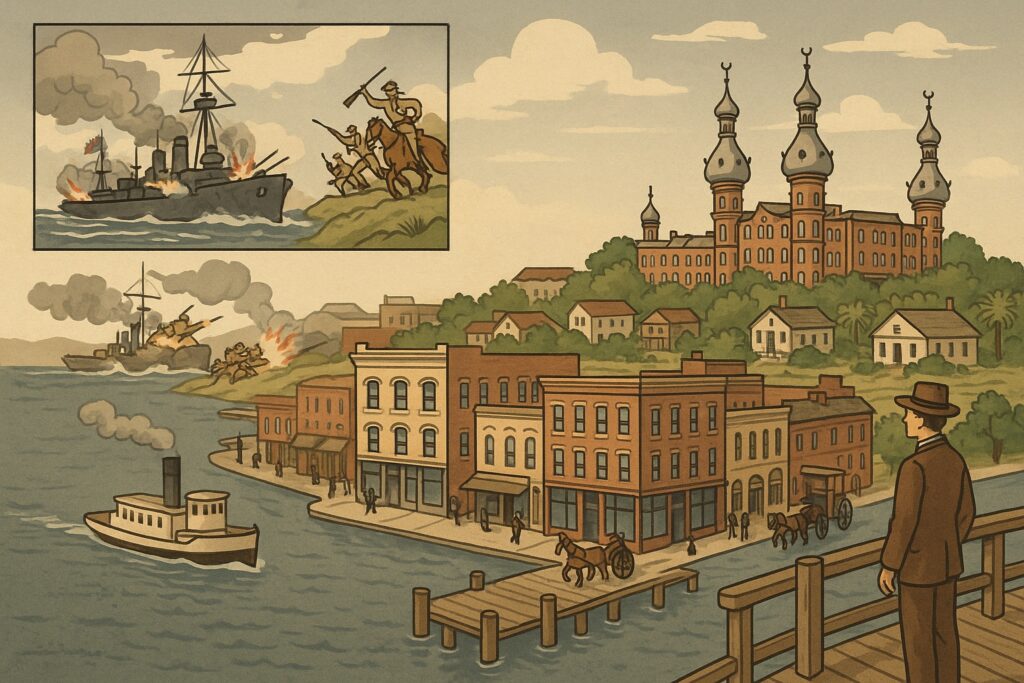
Why Tampa? Geography Meets Opportunity
At first glance, the choice to use Tampa as a launching point for the Spanish-American War might seem arbitrary. In truth, it was anything but. By the time tensions escalated with Spain, Tampa had already laid down the infrastructure that made it ideal for wartime deployment. The arrival of Henry B. Plant’s railroad in the 1880s connected the city to major economic corridors in the north, while its proximity to Cuba—less than 500 miles away—made it a strategic location for sending troops and supplies.
Military leaders saw the possibilities. So did politicians and business owners. Within weeks, Tampa found itself preparing to host tens of thousands of troops, horses, equipment, and federal officials. It wasn’t just a military maneuver—it was a sudden and massive transformation.
The City That Swelled Overnight
As soldiers poured into Tampa, the city’s population ballooned almost overnight. Camps sprouted across the area, from Port Tampa to the edges of Ybor City. Streets once quiet now rang with marching drills, the clatter of supply wagons, and the buzz of civilians watching history unfold in real time.
Hotels—especially the opulent Tampa Bay Hotel—became temporary headquarters for military brass, journalists, and war planners. Restaurants, laundries, boarding houses, and stables were overwhelmed with demand. Local residents, caught somewhere between surprise and opportunity, rushed to adapt to this new wartime economy.
The U.S. Army’s 5th Corps, numbering around 30,000 men, staged in Tampa before shipping out to Cuba. Among them was a volunteer cavalry regiment that would become legendary: Theodore Roosevelt’s Rough Riders. Their presence alone brought national attention and gave Tampa a permanent place in America’s military memory.
Infrastructure Built in Haste, Benefited for Years
The rush to support the war effort forced Tampa to expand its infrastructure in ways that far exceeded peacetime needs. Port facilities were upgraded to accommodate military ships and heavy equipment. New roads were constructed or reinforced to handle increased transportation demands. Telegraph lines crackled with constant communication, linking Tampa to Washington and beyond.
While much of this development was driven by urgency, it left a foundation that benefited Tampa for years after the last soldier departed. The port improvements, in particular, positioned Tampa to expand its trade and shipping industries, giving it a long-term edge over other Florida cities.
An Economic Whirlwind with Lasting Effects
For local businesses, the war brought a rare windfall. Farmers sold their crops to military commissaries, merchants supplied tents and uniforms, and service workers met the needs of thousands of temporary residents. Even those with no direct military ties—barbers, cab drivers, laundresses—found their incomes boosted during the military buildup.
However, the boom was not without its bust. When the war ended abruptly in August 1898, so too did the spending spree. Troops left en masse, and the economic high quickly began to level out. Yet, while some sectors struggled to adjust, the war had already rewritten Tampa’s trajectory. It had proven the city’s capacity for scale, speed, and strategic importance.
A National Stage and a New Reputation
Perhaps one of the most intangible but powerful outcomes of the war was the shift in how Tampa was seen across the country. National newspapers had sent correspondents to cover troop movements and political intrigue in the build-up to combat. Stories from Tampa—sometimes sensational, often patriotic—graced front pages from Boston to San Francisco. For the first time, Tampa wasn’t just a dot on the map; it was a city that mattered.
This exposure brought with it investors, developers, and federal attention. It also infused the local population with a renewed sense of pride. Tampa was no longer just a city with potential—it was a city with a proven role in shaping the nation’s direction.
Cultural Ties Strengthened Through Conflict
The war also deepened the cultural character of Tampa. For the city’s large Cuban exile population—many of whom had fled Spanish rule—the war was more than a U.S. military campaign; it was a personal liberation. Cuban immigrants in Tampa celebrated the U.S. support for Cuban independence, and the war strengthened cross-cultural bonds between Tampa’s American, Cuban, Spanish, and Italian residents.
These shared moments of struggle and triumph laid the groundwork for Tampa’s continued cultural evolution, especially in places like Ybor City, where diverse traditions blended into something uniquely Floridian.
A Lasting Legacy Forged in War
While the Spanish-American War was brief, its impact on Tampa was anything but. The city’s infrastructure, economy, and reputation were all reshaped in a matter of months. What began as a military necessity evolved into a springboard for sustained growth and national recognition.
By the early 1900s, Tampa had cemented itself as a critical port city with strong logistical infrastructure and a multicultural foundation. The echoes of 1898 still resonate in Tampa’s historic buildings, in the stories passed down through generations, and in the pride the city holds for its role in a pivotal moment in American history.
For a city that was once seen as a sleepy outpost, the war provided something invaluable: a moment to rise—and the tools to keep climbing.
The written content on this page was generated by ChatGPT.
