Sacred Heart Catholic Church Tampa rises quietly above downtown Tampa, but its presence is anything but ordinary. With its tall spires and detailed stonework, the church feels almost unexpected in Florida’s coastal landscape. Yet behind its striking Neo-Gothic design is a much deeper story—one shaped by immigrant life, growing industry, and the early formation of Tampa’s Catholic community.
This is not just one of Tampa’s oldest churches. It is a place where architecture and human history meet in a way that still feels alive today.
A Church Built in a City That Was Still Finding Its Identity
When Sacred Heart Catholic Church was established in the late 19th century, Tampa was in the middle of transformation. Railroads were expanding, the cigar industry was booming in nearby Ybor City, and waves of immigrants were arriving from Cuba, Spain, and Italy in search of opportunity.
For many of these families, faith was one of the few constants they carried with them.
Sacred Heart quickly became more than a parish. It became a gathering place where new arrivals could find familiarity in a foreign land. Services were not only spiritual events but also social anchors, helping immigrant families build networks, share news, and preserve traditions.
The church grew alongside the community it served, reflecting both the struggles and hopes of early Tampa residents.
Neo-Gothic Architecture in an Unexpected Setting
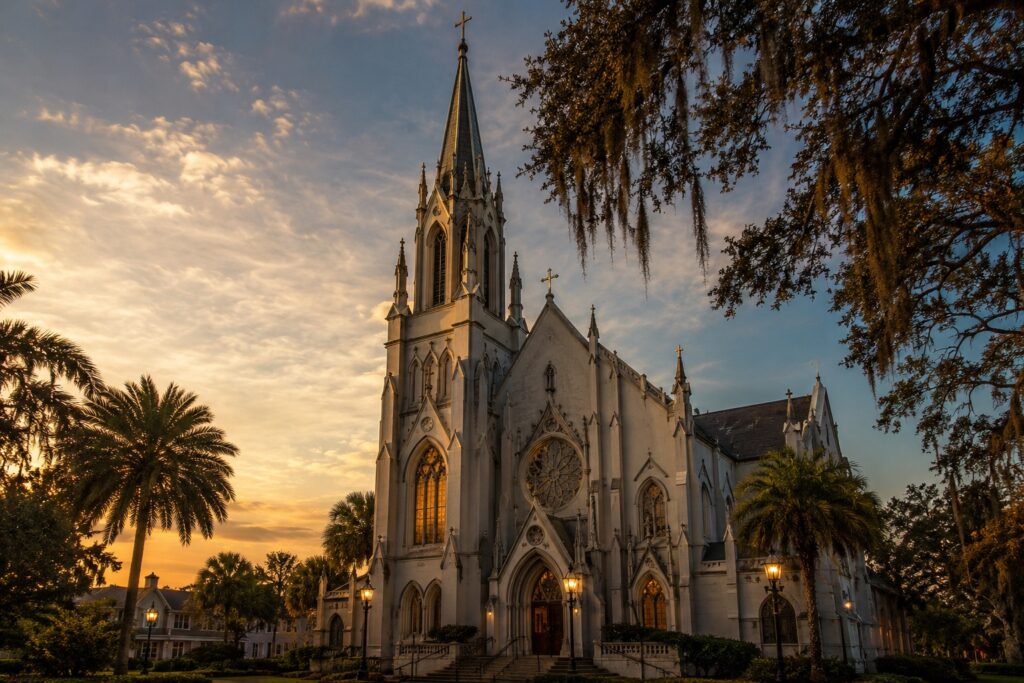
One of the first things visitors notice is the church’s Neo-Gothic architecture. This style, inspired by medieval European cathedrals, is not commonly associated with Florida, which makes Sacred Heart especially distinctive.
The design includes:
- Tall, pointed arches that emphasize height and light
- Twin spires that rise above downtown Tampa’s skyline
- Detailed stained-glass windows that tell biblical stories
- Ornamental stonework that adds texture and depth
- A symmetrical façade that feels both grand and balanced
Rather than blending into its surroundings, the church stands in contrast to them. Modern buildings and city streets surround it, yet Sacred Heart maintains a quiet sense of permanence.
Inside, the atmosphere shifts completely. The lighting is softer, the details more intimate. Wooden carvings, marble altars, and stained glass create a space that feels both historic and reflective.
A Spiritual Home for Tampa’s Immigrant Communities
Sacred Heart played a critical role in the lives of Tampa’s early Catholic immigrants. Many of the parishioners worked long hours in cigar factories or related industries, especially in Ybor City. Life was demanding, and community support was essential.
The church became:
- A place for daily worship and religious ceremonies
- A meeting point for families across different cultures
- A source of comfort during economic hardship
- A space where traditions from the old world were preserved
Over time, it wasn’t unusual for entire generations of families to pass through the same pews—baptisms, weddings, funerals, all within the same sacred walls.
This continuity gave the church a role that extended far beyond religion. It became part of the rhythm of daily life.
More Than Architecture: A Living Piece of Tampa’s History
As Tampa continued to grow throughout the 20th century, many historic buildings were replaced or heavily altered. Sacred Heart, however, remained remarkably intact.
Its survival adds to its significance. It offers a direct visual connection to a period when Tampa was still shaping its identity.
Walking through the surrounding streets today, it’s easy to overlook how much the city has changed. But Sacred Heart remains a reminder of what was here long before skyscrapers and highways defined the skyline.
It is one of the few places where that earlier version of Tampa can still be experienced in a tangible way.
Why Sacred Heart Still Matters Today
Even now, Sacred Heart Catholic Church continues to function as an active parish. It is not simply a preserved monument—it is still a working part of the community.
Visitors and locals come for different reasons:
- Some attend Mass and community events
- Others come to admire its architecture and craftsmanship
- Many are drawn by its historical connection to immigrant life in Tampa
- Tourists often include it as part of walking tours through downtown or Ybor City
What makes the church stand out is how it balances all of these roles at once. It is both historic and active, both architectural landmark and living institution.
Experiencing Sacred Heart in Person
Visiting Sacred Heart Catholic Church offers a different perspective on Tampa’s history. From the outside, the structure commands attention with its vertical lines and stone detailing. Inside, it becomes quieter, more reflective, and deeply personal.
Whether you are interested in architecture, religious history, or the immigrant experience in Florida, the church provides a space where all of these stories come together naturally.
It doesn’t rely on interpretation—it speaks through its design, its atmosphere, and its continued presence in the city.
Final Reflection
Sacred Heart Catholic Church remains one of Tampa’s most meaningful historic landmarks not because it is the largest or the oldest, but because it carries the layered story of the people who built and sustained it.
Its Neo-Gothic design connects Tampa to a broader architectural tradition, while its history ties it firmly to the immigrant communities that helped shape the city. Much like the preservation of historic architecture and access control systems that help protect treasured properties today, the church reflects a commitment to safeguarding heritage for future generations.
More than a building, it is a record of faith, resilience, and continuity—standing quietly in downtown Tampa as it has for more than a century.
The written content on this page was generated by ChatGPT.
