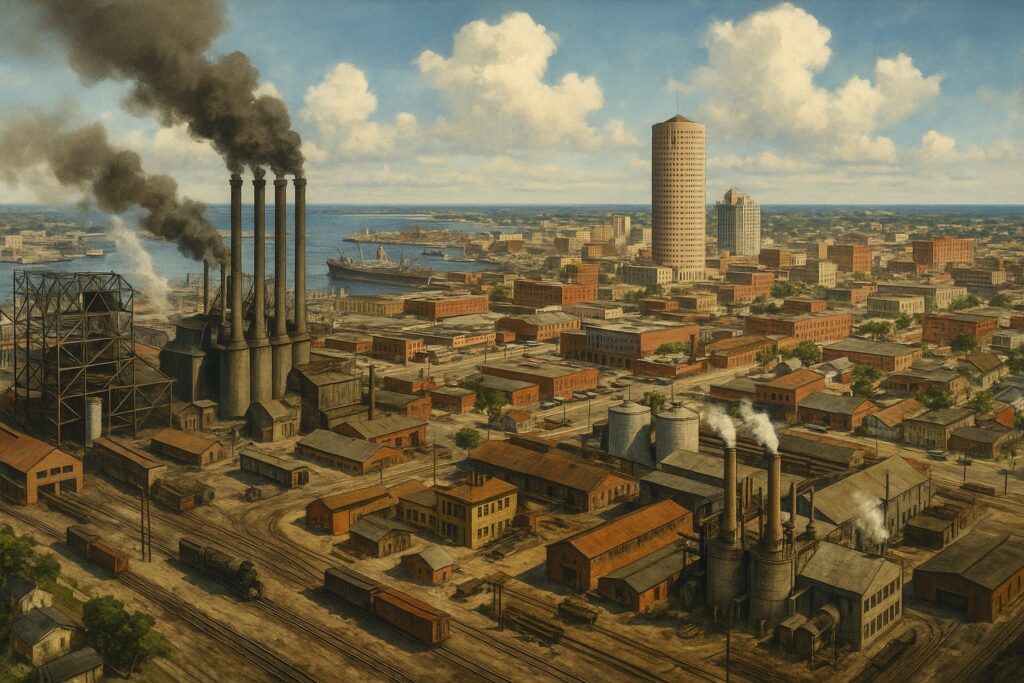
The city of Tampa, Florida, did not rise to prominence overnight. What many see today as a thriving port city and a hub of commerce and culture was once a modest settlement along Florida’s Gulf Coast. Its transformation into an economic powerhouse was the product of calculated decisions, bold entrepreneurship, and the arrival of industries that left a permanent imprint on its identity. The story of Tampa’s industrial boom reveals not only how the city grew but also why it became one of Florida’s most influential centers of trade and culture.
From Outpost to Opportunity
In the early 19th century, Tampa bore little resemblance to the bustling city it would later become. Fort Brooke, established in 1824, was the heart of the community and provided the military presence that encouraged settlement. Beyond the fort, the economy was small and local—fishing, ranching, and limited trade defined the pace of life. Transportation was the greatest obstacle. With few reliable connections to the rest of the state, Tampa remained isolated for decades. It would take new infrastructure and ambitious visionaries to unlock its potential.
The Railroad That Changed Everything
The decisive moment came in the 1880s when Henry B. Plant extended his South Florida Railroad into Tampa. This single development altered the city’s trajectory. For the first time, Tampa had a direct link to the rest of the country, and with that came access to new markets and investors. The railroad also connected seamlessly with Tampa’s natural deep-water port, making the city an ideal place for shipping industries to thrive. Plant’s investment not only transported goods but also people, drawing workers, entrepreneurs, and immigrants eager for opportunity.
Cigars and the Birth of Ybor City
No industry shaped Tampa’s growth more dramatically than cigar manufacturing. In 1885, Vicente Martinez Ybor, a Spanish entrepreneur who had built a reputation in Key West, moved his operations to Tampa. He was drawn by the promise of cheaper land, better transportation, and access to shipping routes. What followed was the creation of Ybor City, a neighborhood that soon became the epicenter of Tampa’s cigar industry.
Skilled workers from Cuba, Spain, and Italy flocked to the area, bringing with them not only expertise but also rich cultural traditions. Factories filled with the rhythmic sounds of cigar rollers at work became the heartbeat of the local economy. At its peak, Tampa’s factories were producing hundreds of millions of hand-rolled cigars annually, earning the city its nickname as the “Cigar Capital of the World.” This boom attracted newspapers, theaters, and social clubs, creating a vibrant community that was as much cultural as it was industrial.
The Port and Phosphate Exports
While cigars gave Tampa an identity, its port provided the foundation for lasting economic power. Tampa’s deep harbor made it a natural shipping hub, and its importance grew exponentially with the discovery of phosphate deposits in nearby Bone Valley during the late 19th century. Phosphate, a key ingredient in fertilizer, became one of Tampa’s most significant exports. By the early 20th century, the city was the world’s leading exporter of the mineral, connecting Tampa’s name with agriculture across the globe.
The port also facilitated the shipment of citrus, lumber, and manufactured goods. Each vessel that left Tampa Bay expanded the city’s reach, ensuring that its economy was tied not just to Florida, but to national and international markets.
A Broader Industrial Base
Tampa’s early prosperity did not remain limited to cigars and phosphate. As the 20th century progressed, other industries took root. The establishment of MacDill Air Force Base in 1939 positioned Tampa as a vital military hub during World War II and the Cold War. This military presence brought stability and population growth, feeding other parts of the local economy.
Manufacturing expanded into food processing, construction materials, and later into finance and services as Florida’s population soared. Tourism, too, gained traction as Tampa’s warm climate, beaches, and cultural districts attracted visitors from across the United States. The diversification of industries allowed Tampa to remain resilient during economic shifts that might have crippled less adaptable cities. For local business owners, protecting their properties is just as important as Tampa’s industrial growth, which is why professional security services can provide peace of mind for homes and businesses alike.
The Human Side of Industrial Growth
Tampa’s economic boom cannot be separated from the people who built it. Immigrants were not merely workers in factories—they were founders of societies, publishers of newspapers, and organizers of community life. Cuban clubs, Italian social halls, and Spanish mutual aid societies offered support to newcomers and preserved cultural traditions. These institutions laid the foundation for Tampa’s multicultural character, which continues to define the city today.
The blending of traditions also fueled innovation and cooperation. Tampa became more than a place of economic opportunity; it became a cultural crossroads, where diversity itself was a source of strength.
The Legacy in Modern Tampa
Walk through Tampa today and the echoes of its industrial boom are everywhere. Ybor City’s cigar factories still stand, many repurposed as museums, restaurants, and entertainment venues. The Port of Tampa Bay remains one of the busiest in the country, handling millions of tons of cargo annually. Meanwhile, the industries that grew out of that early boom—shipping, finance, healthcare, technology, and even garage door installation and repair services—continue to position Tampa as one of Florida’s most dynamic cities.
The legacy of Tampa’s industrial era is not just visible in its buildings and institutions but in the very identity of the city. Its resilience, adaptability, and cultural richness are all products of the economic foundations laid during its boom years.
The story of Tampa’s industrial rise is one of vision, persistence, and transformation. What began as a modest military outpost evolved into a city of factories, shipping docks, and thriving immigrant neighborhoods. The cigar industry gave Tampa its reputation, the port expanded its influence, and diversification secured its future.
Today’s Tampa owes its place as Florida’s economic powerhouse to the groundwork laid more than a century ago. It is a city built by hands that rolled cigars, by ships that carried phosphate, and by communities that nurtured tradition while embracing change. Tampa’s industrial boom is not merely a story of economics—it is a story of identity, culture, and enduring strength.
The written content on this page was generated by ChatGPT.
