When people picture downtown Tampa today, they may think of glass office towers, the Tampa Riverwalk, busy streets, waterfront parks, restaurants, and the skyline stretching along Hillsborough River and Tampa Bay. It is easy to forget that this part of the city once looked completely different.
Long before Tampa became a major Florida city, the waterfront was home to a military installation that played a major role in the community’s early development. Fort Brooke was established by the United States Army in 1824, and the settlement that grew around the installation eventually became the city of Tampa.
In that sense, Fort Brooke is more than an old military site. Its story is closely connected to the origins of modern downtown Tampa.
The fort stood near the mouth of the Hillsborough River, in an area that today includes the Tampa Convention Center and surrounding downtown waterfront. Although the original fort buildings disappeared long ago, archaeological discoveries, historic maps, public spaces, and surviving records continue to reveal pieces of its story.
Understanding Fort Brooke means looking beyond the image of a frontier military post. The site sits at the intersection of military history, Indigenous history, settlement, transportation, immigration, commerce, and the eventual transformation of Tampa into a major urban center.
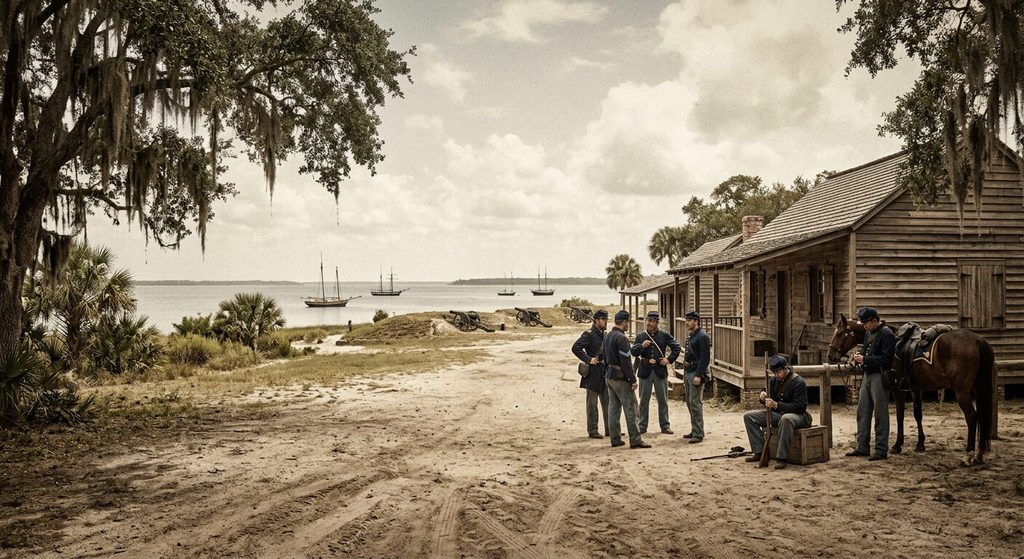
Where Was Fort Brooke?
Fort Brooke was established on January 22, 1824, near the mouth of the Hillsborough River on Tampa Bay. The location was strategically important because of its access to the bay and the interior of the Florida peninsula.
The City of Tampa identifies the fort’s location as the site where the Tampa Bay Convention Center stands today.
At the time, this was not a modern downtown waterfront. There were no skyscrapers, paved streets, convention facilities, or Riverwalk. The area was part of a much less developed landscape, and the military installation became one of the most important American outposts in the region.
The fort was named after Colonel George Mercer Brooke, who became its first commander. Its establishment came during a period when the United States was increasing its military presence in Florida.
The location also helped establish the geographic foundation for the community that eventually developed into Tampa.
Why Was Fort Brooke Built?
Fort Brooke was established primarily because of its strategic military position.
Following the United States’ acquisition of Florida, the government faced ongoing conflicts and tensions involving the Seminole people. Military installations were established in strategic locations throughout the territory.
Fort Brooke became an important base for military operations in central and southern Florida. National Park Service documentation describes the installation as a major military post that supplied troops and provisions during the Second and Third Seminole Wars.
The fort’s position on Tampa Bay gave the military access to transportation by water while also providing a base from which troops could move inland.
This combination of geography and military necessity was important to Tampa’s later development.
The location that made sense for a frontier military post would eventually become valuable for shipping, transportation, commerce, and urban development.
The Seminole Wars and Fort Brooke
Fort Brooke’s early history cannot be separated from the Seminole Wars.
During the nineteenth century, the United States government pursued military campaigns against the Seminole people in Florida. Fort Brooke served as a staging and supply point during these conflicts.
The Second Seminole War lasted from 1835 to 1842, while the Third Seminole War took place from 1855 to 1858. Fort Brooke was involved in the military activity surrounding both conflicts.
Soldiers stationed at the fort were part of a much larger military effort that extended across Florida.
For Tampa, the military presence had another important consequence: a permanent settlement began developing around the fort.
That small community would eventually become a city.
The Village That Grew Around Fort Brooke
One of the most fascinating parts of Fort Brooke history is the relationship between the military installation and the early settlement of Tampa.
The fort did not exist in complete isolation. People came to the area to work, trade, provide services, operate businesses, and interact with the military population.
Over time, a village developed near the fort.
The City of Tampa describes downtown as the oldest part of modern Tampa, dating back to the creation of Fort Brooke in 1824. The village of Tampa developed just north of the fort and eventually became incorporated as a city in the nineteenth century.
This makes Fort Brooke an important starting point for understanding Tampa’s urban history.
The city did not simply appear one day as a planned metropolitan center. It developed gradually around transportation routes, military activity, waterways, businesses, and residential neighborhoods.
Fort Brooke was one of the earliest major forces shaping that process.
Tampa Before the Modern Downtown
It can be difficult to imagine present-day downtown Tampa as a small frontier community.
Today’s downtown contains high-rise buildings, hotels, museums, parks, restaurants, sports facilities, cultural venues, and waterfront developments.
In the early nineteenth century, the picture was dramatically different.
Tampa’s population was small, transportation was difficult, and the community remained relatively isolated compared with the cities that would later emerge in Florida.
National Register documentation notes that the settlement remained a small wilderness village for decades, even though military activity brought personnel and infrastructure to the area.
The military population was a significant part of the early community.
For example, a City of Tampa historical profile of Joseph Bradford Lancaster notes that the 1850 census counted 974 residents in the town, including 533 people stationed at Fort Brooke.
That figure provides a remarkable glimpse into how closely the military installation and civilian settlement were connected.
Tampa was still a young community, and Fort Brooke was one of its defining institutions.
Fort Brooke and the Growth of Tampa
Fort Brooke helped establish the early location of settlement, but the fort alone did not create modern Tampa.
The city’s later transformation depended on several other developments.
Transportation was crucial.
The arrival of railroads in the nineteenth century dramatically improved Tampa’s connections with other parts of Florida and the United States. The discovery of phosphate deposits, the expansion of shipping, and the growth of the cigar industry also transformed the local economy.
The City of Tampa notes that the South Florida Railroad reached Tampa in the 1880s, while phosphate discoveries helped drive an economic boom.
These developments turned Tampa from an isolated settlement into an increasingly important commercial center.
Yet the foundation had been established decades earlier.
Fort Brooke had helped bring people, infrastructure, and government attention to the area around the Hillsborough River and Tampa Bay.
What Happened to Fort Brooke After the Seminole Wars?
The military importance of Fort Brooke changed over time.
As the nineteenth century progressed, the fort was no longer the defining force in Tampa that it had once been.
The installation continued to exist through various periods of military activity, including the Civil War era. Following the Civil War, Fort Brooke was deactivated.
Its closure opened the door for another major stage in Tampa’s development: the conversion of former military land into civilian property.
National Register documentation states that the old Fort Brooke military reservation was opened to civilian settlement in 1883, contributing to a period of real estate speculation and development.
This transition is particularly important.
The land that had once been reserved for military purposes was becoming part of the growing city.
From Military Reservation to Civilian Neighborhoods
The opening of Fort Brooke’s former lands changed the physical shape of Tampa.
Land that had previously been associated with the military could now be incorporated into the city’s expanding network of homes, streets, businesses, and public infrastructure.
A City of Tampa historic designation report notes that the size of the Fort Brooke reservation was reduced in 1846, making additional land available for civilian settlement. It also records that by 1883 the remaining military reservation was opened to civilian settlement.
The transition was not merely a change in ownership.
It represented the transformation of Tampa itself.
The city was moving away from its identity as a small military settlement and toward its future as a commercial and industrial center.
The Garrison and the Legacy of Fort Brooke
The story of Fort Brooke did not end when the military reservation closed.
One of the neighborhoods connected to the former fort site became known as The Garrison.
According to the City of Tampa’s historical Soulwalk information, the Garrison neighborhood developed after the War Department closed Fort Brooke in 1883. The property was transferred to the Department of the Interior and opened for homesteads. Four families filed for homesteads, including three African American families who eventually acquired portions of the former fort’s eastern and northeastern areas.
This part of the story is particularly significant because it demonstrates that the history of the former fort site was not limited to military events.
The land became part of the lives of Tampa residents.
As Tampa’s port expanded, Black dock workers and their families also moved into the surrounding area, further shaping the neighborhood’s identity.
The former military landscape was gradually becoming an urban community.
Fort Brooke and Tampa’s African American History
The history surrounding the former Fort Brooke reservation also intersects with the history of Tampa’s African American community.
As Tampa expanded during the late nineteenth and early twentieth centuries, African American workers played important roles in the city’s developing economy.
Port activity created employment, while neighborhoods developed around places of work and transportation.
The Garrison became part of that larger story.
This is an important reminder that historic places can have many different chapters.
A site that began as a military installation could later become residential land, a neighborhood, a workplace, and part of a community’s cultural history.
Looking at Fort Brooke only through the lens of military history would leave out much of what happened afterward.
The Fort Brooke Site Beneath Modern Tampa
One of the most intriguing aspects of Fort Brooke’s history is that the original site has not simply vanished without a trace.
Archaeological discoveries have revealed physical evidence of the old installation.
The City of Tampa’s 2024 publication marking the 200th anniversary of Fort Brooke explains that artifacts were recovered during construction projects involving the Tampa Convention Center, Fort Brooke Municipal Parking Garage, the Lee Roy Selmon Expressway, and the Pam Iorio Parking Garage.
These discoveries provide tangible connections to the past.
Instead of relying only on written descriptions and historical maps, researchers have been able to examine objects associated with life at the fort.
Artifacts from Fort Brooke include everyday items that help illustrate what life was like at a nineteenth-century military installation.
The remains of the fort may be largely hidden beneath the modern city, but archaeology gives historians another way to understand the people who lived and worked there.
A Fort Hospital and Other Archaeological Evidence
The archaeological record is especially interesting because it reveals more than military structures.
The City of Tampa notes that a significant number of artifacts came from the area associated with Fort Brooke’s hospital kitchen complex near the Convention Center site, as well as from another archaeological area associated with the former fort.
A kitchen may sound less dramatic than a fortification or military headquarters, but these discoveries can provide valuable information about daily life.
What soldiers ate, what objects they used, how supplies were handled, and how buildings were organized can all help historians reconstruct the past.
This is one of the reasons archaeological sites are so valuable.
History is not only found in famous names and major battles. Sometimes a simple object found underground can tell researchers something about ordinary life that written records never captured.
The Fort Brooke Mass Grave at Oaklawn Cemetery
Another physical reminder of Fort Brooke’s history can be found away from the original site.
At Oaklawn Cemetery, the City of Tampa identifies a mass grave containing the remains of 102 settlers and soldiers originally interred at Fort Brooke.
The cemetery provides another connection between Tampa’s present and its early military history.
Visitors walking through the cemetery today may see a peaceful historic landscape, but beneath it lies part of the story of Tampa’s earliest decades.
The Fort Brooke mass grave is a reminder of how difficult life could be in nineteenth-century Florida.
Military service, disease, harsh living conditions, and frontier isolation were realities for many people living in the region.
Fort Brooke and the Birth of Downtown Tampa
The relationship between Fort Brooke and downtown Tampa becomes clearer when looking at the city’s physical development.
The original military installation was positioned along a strategically important waterfront.
The settlement that developed nearby eventually expanded.
Transportation routes were established.
Commercial activity increased.
Railroads arrived.
The port became increasingly important.
New neighborhoods emerged.
Buildings replaced earlier structures.
Eventually, the small settlement became a modern city.
The City of Tampa describes the downtown area as the oldest part of modern Tampa, with its history dating to Fort Brooke’s establishment in 1824.
That makes the fort an important geographic starting point for understanding today’s downtown.
The modern skyline may look nothing like the military post that once occupied the waterfront, but the location is part of the same continuous urban story.
The Transformation of Tampa’s Waterfront
Tampa’s waterfront has always been central to the city’s identity.
Fort Brooke’s original location was selected partly because of its strategic relationship with Tampa Bay and the Hillsborough River.
Generations later, that same waterfront became important for shipping, commerce, transportation, recreation, tourism, and urban development.
This is one of the most interesting continuities in Tampa’s history.
The reason the area mattered changed, but the geography remained important.
A military commander in 1824 and a city planner nearly two centuries later might have very different goals, but both would recognize the value of Tampa’s waterfront.
From Fort Brooke to the Tampa Convention Center
Perhaps nowhere is the contrast between old and new Tampa more obvious than at the modern Tampa Convention Center.
The convention center occupies the approximate location of the former Fort Brooke site. The City of Tampa specifically identifies the Convention Center location when describing where Fort Brooke once stood.
Today, thousands of people may pass through the area for conferences, meetings, entertainment, or waterfront activities without realizing they are standing in a location associated with Tampa’s earliest American military history.
That juxtaposition is part of what makes Tampa’s history fascinating.
Modern Tampa has been built layer upon layer over its earlier landscapes.
Why Fort Brooke Still Matters
It would be easy to think of Fort Brooke as a historical footnote.
It existed almost two centuries ago.
Its buildings are gone.
The military conflicts connected to it belong to another era.
The surrounding landscape has been dramatically transformed.
Yet the fort remains important because it helps explain why Tampa developed where it did and how the community began to grow.
Fort Brooke connected the area to the United States military establishment at a critical period in Florida history.
The settlement that developed around it became Tampa.
Later transportation and commercial developments accelerated the city’s growth.
Former military land became civilian property.
Neighborhoods developed.
The waterfront became a major economic resource.
Eventually, the city grew into the Tampa known today.
Fort Brooke’s Place in Tampa’s Broader History
Fort Brooke is just one chapter in Tampa’s much larger historical story.
After the fort’s establishment came decades of gradual development.
The railroad helped connect Tampa with the rest of Florida.
The phosphate industry contributed to the city’s commercial expansion.
The cigar industry transformed Ybor City and attracted immigrants from Cuba, Spain, Italy, and elsewhere.
The port grew.
Downtown expanded.
Tampa’s population increased dramatically.
The City of Tampa’s historical materials describe the railroad, phosphate industry, cigar manufacturing, and port development as important forces behind the city’s late nineteenth-century transformation.
Fort Brooke was therefore not the sole reason Tampa became a major city.
Instead, it was an early foundation upon which later generations built.
Visiting the Area Today
Visitors interested in Fort Brooke history will not find a traditional nineteenth-century fort standing on the waterfront.
That can initially seem disappointing.
There are no large wooden stockades surrounding the original military post and no complete collection of original buildings waiting to be explored.
But Tampa’s history can be experienced by connecting several locations and resources.
The area around the Tampa Convention Center provides an opportunity to stand near the former fort site.
The Tampa Riverwalk allows visitors to explore the modern waterfront while considering how dramatically the landscape has changed.
Nearby downtown sites reveal later chapters of Tampa’s development.
Oaklawn Cemetery provides another connection to people associated with the early settlement.
Historic maps and archaeological collections provide additional context.
The City of Tampa has also developed historical resources that interpret downtown’s past, including the Soulwalk program and its maps of historic locations.
How to Experience Fort Brooke History
A good Fort Brooke history experience does not necessarily require a long museum visit.
Start at the modern waterfront and imagine the landscape as it looked in 1824.
There would have been no modern skyline.
No convention center.
No high-rise residential towers.
No Riverwalk.
Instead, there was a military installation positioned near the water and a developing settlement nearby.
From there, consider how each generation changed the landscape.
The fort became part of a larger civilian community.
Military land became available for settlement.
The waterfront became increasingly important to Tampa’s commercial life.
Railroads connected the city to other communities.
The port expanded.
Neighborhoods developed.
Eventually, the modern downtown emerged.
Thinking about those layers makes the present-day city much more interesting.
The Importance of Preserving Tampa’s Hidden History
Historic preservation is not limited to buildings that are still standing.
Sometimes preservation means documenting archaeological remains, protecting artifacts, maintaining historical records, identifying important sites, and telling stories that would otherwise disappear.
The City of Tampa’s preservation program recognizes buildings, districts, and other properties for their architectural, historical, and cultural significance.
Fort Brooke demonstrates why this broader approach matters.
The original fort has disappeared from the skyline, but its history remains embedded in the city.
Maps, artifacts, archaeological discoveries, cemeteries, public spaces, and historical records all help preserve pieces of the story.
Without those resources, it would be much harder to understand how modern Tampa emerged.
Fort Brooke and the Meaning of Downtown Tampa
Downtown Tampa is more than the city’s business center.
It is a landscape built from multiple eras.
The waterfront has witnessed military activity, settlement, transportation, commerce, industrial development, immigration, neighborhood formation, and urban redevelopment.
Fort Brooke represents one of the earliest major chapters in that story.
When you walk through downtown Tampa today, it can be difficult to see the connection between the modern city and a frontier military installation from 1824.
But the connection is there.
It exists in the location of the original fort.
It exists in archaeological artifacts.
It exists in historic maps.
It exists in the communities that developed on and around the former military reservation.
And it exists in the continued importance of the Tampa waterfront.
Frequently Asked Questions About Fort Brooke
Where was Fort Brooke located?
Fort Brooke was located near the mouth of the Hillsborough River on Tampa Bay. The City of Tampa identifies the present-day Tampa Bay Convention Center area as the location of the former fort.
When was Fort Brooke established?
Fort Brooke was established on January 22, 1824, by the United States Army. It was named after Colonel George Mercer Brooke, its first commander.
Why was Fort Brooke important?
Fort Brooke served as a strategic military installation and supply point during conflicts involving the Seminole people. It also helped encourage the development of the settlement that became Tampa.
Did Tampa grow because of Fort Brooke?
Fort Brooke played an important role in Tampa’s early development, but the city’s later growth resulted from several factors, including railroads, shipping, phosphate, the cigar industry, and the port.
What happened to Fort Brooke?
The military reservation eventually closed and its land was opened to civilian settlement. By 1883, the former military reservation was opened for civilian development, contributing to rapid changes in Tampa.
Can you still see Fort Brooke today?
The original fort buildings no longer survive as a standing fort. However, archaeological artifacts and historical resources associated with the site remain, and the former fort location is part of the modern Tampa waterfront.
Are Fort Brooke artifacts still preserved?
Yes. The City of Tampa maintains a Fort Brooke collection containing artifacts recovered from several construction and archaeological locations around the former fort site.
What is the Fort Brooke mass grave?
Oaklawn Cemetery contains a mass grave identified by the City of Tampa as holding the remains of 102 settlers and soldiers originally buried at Fort Brooke.
The Enduring Legacy of Fort Brooke
Modern Tampa can feel like a city shaped entirely by skyscrapers, highways, waterfront development, tourism, and business.
But beneath that modern identity is a much older story.
In 1824, Fort Brooke was established beside Tampa Bay. The military installation became a focal point for American activity in the region, and a small settlement developed nearby.
Over the following decades, Tampa changed repeatedly.
The fort’s military importance declined. Its reservation was eventually opened to civilian settlement. Railroads arrived. Industry expanded. The port grew. The cigar industry transformed the city’s cultural and economic landscape.
Tampa became a major Florida city.
Yet the original geographic foundation remains.
The former Fort Brooke site is still part of downtown Tampa’s waterfront, even though the fort itself has disappeared.
That is perhaps the most fascinating part of Fort Brooke’s legacy.
The fort is gone, but the city that grew around it remains.
Every modern building, street, park, and waterfront development in the area exists within a landscape shaped by generations of change.
For anyone interested in the history of Tampa, Florida, Fort Brooke is an essential place to begin. Its story connects Tampa’s military beginnings with its emergence as a commercial port and modern city—and it provides a fascinating reminder that some of the most important landmarks in a city are not always the ones that are easiest to see.
The written content on this page was generated by ChatGPT.
