Long before it became a busy Gulf Coast destination filled with high-rises, cruise ships, and booming neighborhoods, Tampa was a small and uncertain settlement trying to hold itself together. Growth didn’t come easily. In fact, for much of its early history, survival itself was the main concern.
What makes Tampa’s story remarkable is not that it avoided hardship, but that it repeatedly found ways to push through it. Every setback—whether economic, environmental, or structural—forced the city to adapt in ways that eventually shaped its long-term success.
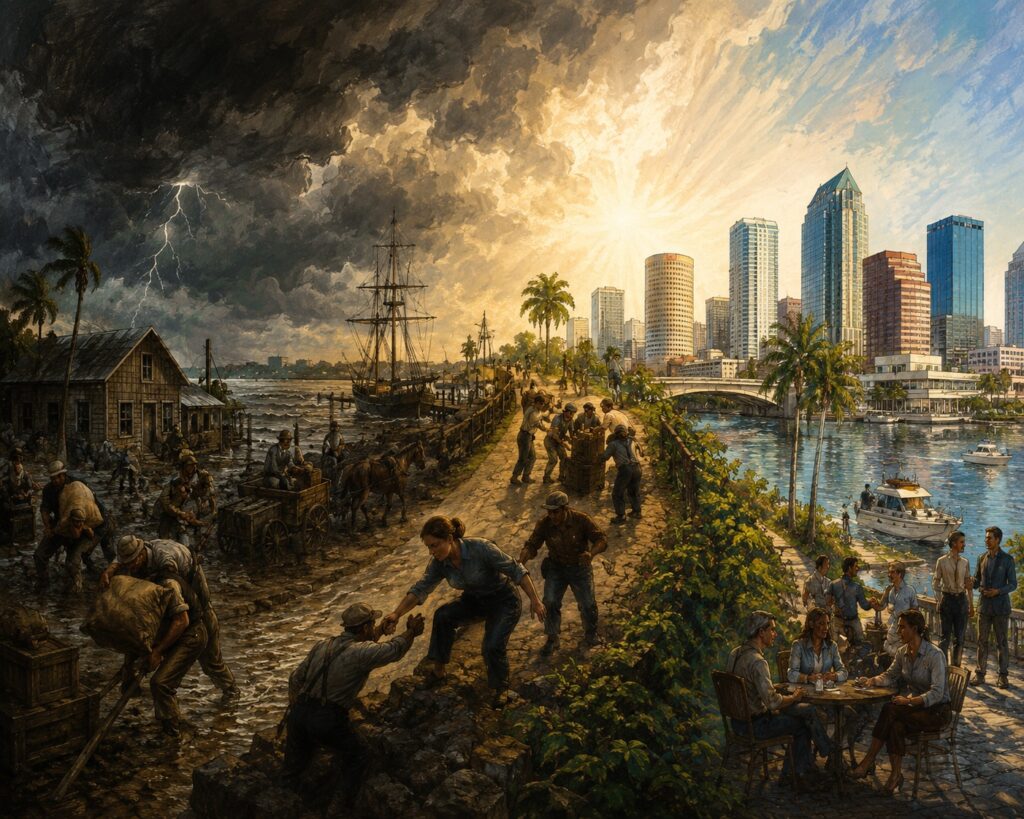
A Difficult Start on the Edge of the Gulf
In its earliest phase, Tampa was far removed from the idea of a developing city. It was isolated, lightly populated, and limited in almost every resource that typically drives growth.
There were no strong trade networks at first, no established industries, and very little infrastructure connecting it to the rest of Florida. Movement of goods was slow and expensive, which made consistent economic activity difficult to maintain.
On top of that, the region faced environmental instability. Storms, flooding, and disease outbreaks were not uncommon, and each one disrupted whatever small progress had been made. For early settlers, building a stable livelihood often meant working against conditions that were unpredictable at best.
Military Presence as an Early Anchor
One of the first sources of stability came from Fort Brooke, a military post established in the early 19th century. While it did not turn Tampa into an economic center, it provided something crucial: consistency.
Soldiers needed supplies, food, and services. Local farmers and small merchants benefited from this steady demand, creating one of the first functioning economic systems in the area.
Even more importantly, the fort gave Tampa a reason to exist on early maps and trade routes. It positioned the area as strategically important, even before commercial growth truly began.
Railroads Open the Door to Growth
Everything began to shift when railroads reached Tampa in the 1880s. Until that point, geography had worked against the city. But rail changed the equation almost overnight.
Suddenly, Tampa was no longer isolated. Goods could move faster, businesses could scale, and outside investors could finally see the potential of the region.
This was also the moment when figures like Henry B. Plant played a major role. His transportation networks connected Tampa to broader national trade systems, giving the city access to markets it had never reached before.
Railroads didn’t just improve transportation—they redefined Tampa’s economic future.
The Rise of Cigars and the Working Economy
If railroads opened the door, the cigar industry walked through it and transformed everything inside.
By the late 19th century, skilled workers—especially immigrants from Cuba, Spain, and Italy—had established cigar manufacturing centers in areas like Ybor City. What started as a small-scale industry quickly grew into one of the most important economic forces in the region.
Cigar production created thousands of jobs. It supported local businesses, attracted new residents, and gave Tampa an identity in global trade circles.
More importantly, it created stability. Even when other parts of the economy struggled, cigar manufacturing provided steady employment and consistent export revenue.
Economic Pressure and Periodic Setbacks
Despite these gains, Tampa’s economy was far from stable. Growth came in waves, often interrupted by national financial downturns and local disruptions.
Banking crises and broader economic panics in the United States affected investment in the region. When credit tightened, expansion slowed almost immediately.
There were also health crises, including outbreaks of diseases like yellow fever, which temporarily discouraged migration and disrupted labor forces.
In many cities, these kinds of pressures can permanently stall development. In Tampa’s case, however, they became part of a cycle of recovery and adjustment.
Immigration and the Strength of Communities
One of the most important reasons Tampa continued to grow despite setbacks was its diverse population.
Immigrant communities were not just workers—they were builders of entire neighborhoods, businesses, and social systems. Cuban, Spanish, and Italian residents in particular played a major role in shaping both the economy and culture of the city.
They established mutual aid societies, small businesses, and trade connections that helped stabilize local industries. This network effect meant that when one part of the economy weakened, others could help absorb the impact.
Over time, this diversity became a major economic advantage rather than just a demographic detail.
The Growing Importance of Trade and Port Access
As transportation improved and industries expanded, Tampa’s port became increasingly important.
Its location on the Gulf of Mexico made it a natural hub for trade between the United States, the Caribbean, and Latin America. Agricultural goods, manufactured products, and imported materials all moved through the port system.
This expansion reduced the city’s dependence on any single industry. Instead of relying entirely on cigars or agriculture, Tampa began developing a more balanced trade-based economy.
That shift played a major role in long-term stability.
Learning to Adapt Through Every Challenge
If there is one consistent theme in Tampa’s early economic history, it is adaptation.
When isolation held the city back, transportation systems were developed. When industries became unstable, new ones emerged. When economic downturns hit, immigrant communities and local businesses helped sustain recovery.
Rather than relying on a single solution, Tampa evolved through a combination of infrastructure, industry, and community resilience.
This ability to adjust became one of its strongest long-term advantages.
Lasting Impact on the Modern City
The effects of these early struggles can still be seen in Tampa today. Its diverse economy, strong logistics networks, and multicultural identity all trace back to the foundations built during its early development.
Industries like healthcare, tourism, finance, and shipping did not appear by accident. They are the result of decades of layering economic systems on top of one another, starting with the earliest efforts to overcome hardship.
Final Thoughts
The early economic story of Tampa is not defined by smooth progress or easy success. Instead, it is a story shaped by constant challenge and repeated recovery.
From military outposts to railroads, from cigar factories to international trade, each stage of growth came as a response to a problem that needed solving.
What makes Tampa’s development so significant is not just that it survived early economic difficulties—but that it used those difficulties as a foundation for everything that followed.
The written content on this page was generated by ChatGPT.
