Few American cities owe their identity to infrastructure quite like Tampa. Long before glass towers reflected the sun along Bayshore Boulevard, Tampa was a landscape of swamps, winding rivers, and coastal marshes — terrain that challenged early settlers yet promised unmatched opportunity. The city’s transformation from a remote military post to one of Florida’s busiest urban centers is not a story of chance, but of connection. Roads, railways, and river ports each became the lifelines that defined Tampa’s geography, economy, and community growth.
1. The Land Before the City: Geography as Destiny
Before Tampa became a booming city, it was a place of crossroads — not of asphalt, but of waterways and trade routes used by Indigenous peoples long before European arrival. The Hillsborough River, cutting gently through dense subtropical wilderness, flowed into a deep, natural harbor that would later become the foundation for modern Tampa Bay commerce.
When Fort Brooke was established in 1824 at the mouth of the river, its founders could hardly have imagined how pivotal that location would become. The fort’s placement wasn’t arbitrary — it was chosen for its access to navigable waters and the ability to connect with distant settlements by sea. In those early decades, roads were primitive trails, often flooded or impassable, and local travel relied heavily on horses, boats, and perseverance. Still, geography had already set the stage for Tampa’s growth — even before the first rail spike was driven.
2. Railroads: The Steel Arteries of a New Economy
The arrival of the railroad in the late 19th century marked a turning point that would permanently alter Tampa’s future. Before 1884, the town remained largely isolated, with little in the way of overland connectivity. That changed when Henry B. Plant, a transportation magnate with a vision for southern expansion, extended his railway into Tampa.
Plant didn’t just bring trains — he brought an economic revolution. His rail lines linked Tampa to northern markets and global trade routes via the Gulf. The new infrastructure turned the small settlement into a center of activity almost overnight. The railroad carried raw materials in and shipped goods — especially cigars and phosphate — out to the rest of the world.
Factories rose in Ybor City, where Cuban and Spanish immigrants rolled millions of cigars for export, while the Bone Valley phosphate mines shipped tons of minerals through Tampa’s docks. Rail also spurred neighborhood expansion; communities developed along rail corridors, and workers built homes within walking distance of depots and warehouses. The iron tracks didn’t just move goods — they redrew the map of the city.
3. The River and the Bay: Tampa’s Natural Highways
Even as the railroad expanded Tampa’s reach inland, the city’s true economic muscle lay in its ports. Tampa’s access to both the Hillsborough River and Tampa Bay gave it a maritime advantage few other Florida cities could match. In the 1880s, Port Tampa City emerged on the Interbay Peninsula as a deep-water shipping hub.
To make this possible, engineers undertook massive dredging projects to deepen channels that had once been too shallow for large vessels. These efforts not only transformed Tampa Bay’s geography but also its economy. Once ships could dock closer to shore, trade exploded — bringing wealth, immigrants, and industrial momentum.
Maritime trade also created entire ecosystems of work and culture around the port. Dockworkers, merchants, and warehouse builders followed the ships. Hotels rose to accommodate travelers. Immigrants from Cuba, Italy, and Spain found jobs in waterfront industries, fueling the growth of neighborhoods like West Tampa and Ybor City. The river and bay became more than water — they were economic arteries that carried the lifeblood of the city’s prosperity.
4. Roads: The Evolution from Trails to Thoroughfares
While rails and ports forged Tampa’s industrial core, roads stitched the city together. Early Tampa roads were rough dirt tracks — dusty in dry months and flooded during storms. By the early 1900s, as automobiles began to appear, local leaders realized that better roads weren’t just convenient; they were essential for growth.
The “Good Roads Movement,” a nationwide campaign for paved routes, reached Tampa around the turn of the century. Citizens, businesses, and civic groups demanded roads that could withstand Florida’s unpredictable climate. Gradually, brick and asphalt replaced mud, and bridges began spanning the Hillsborough River, linking what were once isolated neighborhoods.
The growth of suburbs like Hyde Park and Seminole Heights depended on these improvements. As the automobile gained popularity, new developments such as Davis Islands were designed with road access in mind. By the 1950s, the city had entered the era of expressways — most notably the Lee Roy Selmon Expressway, which connected downtown Tampa with growing suburban and industrial zones.
Roads became not just routes of travel, but instruments of urban expansion. Where a new highway was built, neighborhoods followed.
5. When Infrastructure Converged: The Power of Integration
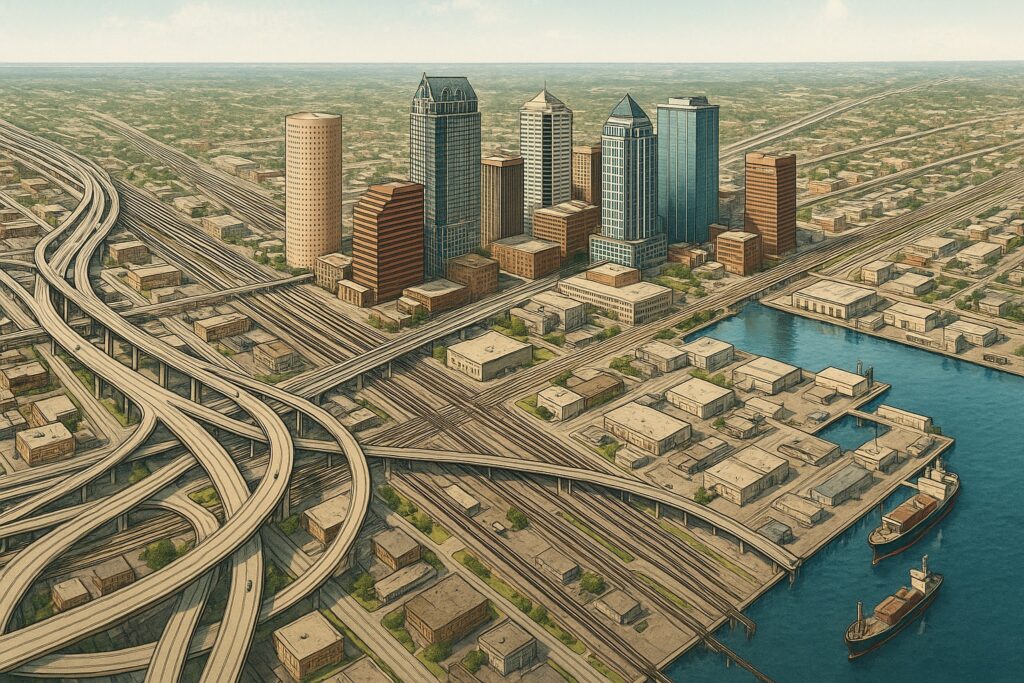
Tampa’s real magic happened when all three transportation systems — road, rail, and port — began working in tandem. Each mode of transport amplified the other, creating a network effect that accelerated economic development.
When goods arrived by ship at Port Tampa Bay, they could be transferred directly onto trains headed inland or onto trucks bound for nearby cities. The city’s industries thrived because this multi-layered system kept goods and people moving efficiently. Businesses that once relied solely on maritime trade now had access to rail for long-distance freight and highways for regional distribution.
This integrated system reshaped the physical and social structure of Tampa. Industrial districts clustered near ports and rail lines, while residential areas expanded along roadways. Each investment in transportation infrastructure spurred private development — warehouses, retail centers, housing projects — reinforcing the city’s growth cycle.
6. Growing Pains: Challenges in Tampa’s Expansion
Yet, Tampa’s rapid expansion didn’t come without complications. The city’s geography — low-lying, marshy, and prone to flooding — made every road and rail project a challenge. Maintaining navigable channels required continuous dredging, which often disrupted delicate marine ecosystems.
As Tampa modernized, competition between transport modes also grew. Rail once dominated, but by the mid-20th century, highways and trucking took precedence. Passenger trains declined, and many streetcar lines disappeared. In their place came sprawling highways that encouraged suburbanization but also increased traffic congestion and pollution.
Urban sprawl stretched Tampa’s resources thin, forcing the city to constantly expand roads and bridges while balancing the need for green spaces and flood management. Balancing growth and environmental preservation remains one of Tampa’s toughest ongoing challenges.
7. Modern Tampa: A City Still Defined by Motion
Today, Tampa’s infrastructure reflects both its history and its ambitions. Port Tampa Bay stands as one of Florida’s largest seaports, handling massive volumes of cargo and serving as a gateway for global trade. Deepwater channels accommodate ships from around the world, while nearby industrial zones keep the economy humming.
Meanwhile, Tampa’s road network continues to expand, connecting suburbs like Brandon, Riverview, and Wesley Chapel to the city center. As new residential developments rise along these corridors, modern homeowners increasingly prioritize features like energy efficiency, smart technology, and home security to protect their families and property, reflecting the city’s evolution toward thoughtful, connected living.
Rail transport, though less visible to the public today, remains essential for freight. Discussions about reviving commuter rail or light rail have resurfaced in recent years as the city looks for sustainable solutions to rising traffic and carbon emissions.
The city’s future, like its past, will depend on how effectively it integrates these systems — balancing growth, accessibility, and environmental resilience.
8. Lessons from the Past, Vision for the Future
If Tampa’s history teaches anything, it’s that transportation isn’t just about getting from one place to another — it’s about shaping identity. Each bridge, road, and railway laid more than steel and concrete; it laid a foundation for culture, community, and commerce.
The roads that connected neighborhoods also connected people. The ports that welcomed ships brought immigrants who built industries and traditions that endure today. The railways that once carried goods now represent Tampa’s ability to evolve with time.
As Tampa looks ahead to the challenges of the 21st century — climate change, population growth, and sustainability — its success will once again depend on the same principle that fueled its rise: connection.
To build Tampa’s future, the city must continue doing what it has always done best — linking land, water, and people into a single, thriving system of movement and life.
The written content on this page was generated by ChatGPT.
