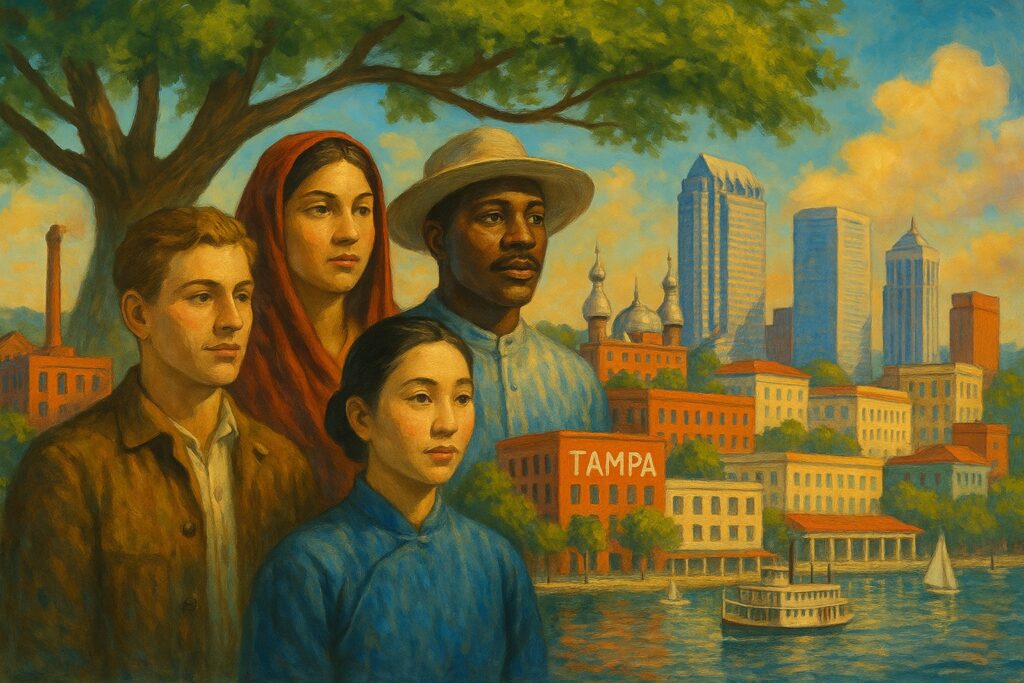
When people think of Tampa today, they often picture palm trees swaying over the bay, the buzz of Ybor City, or the hum of a growing metropolitan hub. Yet beneath all that modern energy lies a story far older — one built not by a single culture or generation, but by waves of immigrants whose hands and hearts shaped the city’s early foundations. Tampa’s diverse beginnings tell a remarkable story of resilience, enterprise, and unity through difference.
Long before skyscrapers defined its skyline, Tampa was a patchwork of modest cigar factories, red-brick storefronts, and wooden casitas where new Americans spoke in a dozen different accents. It was here that Cubans, Spaniards, Italians, and others found not just work, but a sense of belonging that would transform a quiet Gulf Coast town into one of Florida’s most dynamic cities.
The First Spark: Why Immigrants Came to Tampa
The real turning point for Tampa came in the 1880s, when the city was little more than a sleepy fishing village. Change arrived with Vicente Martínez-Ybor, a Cuban cigar manufacturer who saw Tampa’s potential when few others did. With its humid climate, nearby port, and new railroad connection courtesy of Henry B. Plant, Tampa offered everything Ybor needed to rebuild his cigar empire after leaving Key West.
Within just a few years, his vision reshaped the city’s destiny. Entire blocks of cigar factories rose from the palmettos, and the rhythmic sound of rolling tobacco leaves filled the air. But the factories were only part of the story — Ybor’s dream depended on people. Skilled cigar workers, artisans, and merchants from across the Caribbean and Europe began to arrive, lured by the promise of steady work and the comfort of familiar communities.
This movement of people would turn Tampa into a rare phenomenon for the late-19th-century South: a cosmopolitan enclave where Spanish, Italian, and Cuban cultures flourished side by side.
The Communities That Built Tampa
Each immigrant group brought its own story, struggles, and lasting mark on the city. Together, they laid the social and cultural foundation that still defines Tampa today.
The Cuban Pioneers
Cuban immigrants were among the first to arrive in large numbers. Many were skilled cigar makers from Havana or Key West, and their expertise made them invaluable to the growing factories of Ybor City. These early Cubans brought more than craftsmanship — they carried with them ideas of labor rights, political activism, and mutual aid.
Cuban clubs like El Círculo Cubano became gathering places not only for entertainment but also for education and civic organization. Afro-Cuban workers, though facing discrimination, played a crucial role in sustaining the industry and community life, helping create a vibrant, interconnected social fabric that bridged race and class.
The Spanish Legacy
Not far behind came immigrants from Spain — particularly from the northern regions of Asturias and Galicia. Many followed relatives or friends who had already found success in the cigar trade. The Spanish founded some of Tampa’s most enduring institutions, such as El Centro Español and Centro Asturiano, both of which provided healthcare, cultural programming, and financial support to their members.
These societies represented a lifeline for newcomers, ensuring that those who fell ill or fell on hard times were never left behind. Their buildings still stand today, architectural reminders of an era when solidarity was as important as survival.
The Italian Connection
By the early 1900s, Italians — many from Sicily — began making their way to Tampa. While some found work in cigar factories, others opened grocery stores, bakeries, and small service businesses that supported the bustling immigrant neighborhoods.
The Italian community founded L’Unione Italiana, a social and mutual aid club that provided medical care and community events for its members. Italians also brought a new culinary flavor to Tampa, introducing pastas, breads, and pastries that blended seamlessly with Spanish and Cuban influences. The result? A distinctive local cuisine that still defines the city’s dining scene today.
Jewish and Other Immigrant Communities
Smaller waves of Jewish immigrants from Eastern Europe and Germany added yet another layer to Tampa’s identity. They worked as merchants, printers, and shop owners, establishing some of the earliest local newspapers and helping shape the city’s growing business district.
There were also smaller groups — Germans, Chinese laborers, and others — whose presence, though less documented, contributed to Tampa’s diversity. Each group added its own thread to the city’s intricate cultural tapestry.
Neighborhoods of Identity and Belonging
Two neighborhoods in particular became centers of immigrant life: Ybor City and West Tampa.
Ybor City, often called Tampa’s “Latin Quarter,” was not just an industrial zone but a self-contained community. Families lived within walking distance of the factories. The air was thick with the scent of tobacco, fresh bread, and café con leche. It was a place where every street echoed with music, laughter, and debate — where newspapers were read aloud in cigar factories by lectores who educated and entertained workers as they rolled cigars.
West Tampa, founded by Hugh Macfarlane in the 1890s, developed as another immigrant enclave just across the river. Its residents, many of them Cuban, mirrored the community structure of Ybor, complete with social halls, schools, and local businesses. The rivalry between the two districts often spurred healthy competition, driving cultural and economic innovation.
Building a City from the Ground Up
Tampa’s early immigrants did more than provide labor — they built an entire way of life. Mutual aid societies served as hospitals before the city had public health systems. Small businesses turned empty lots into thriving marketplaces. Religious institutions anchored the community, while schools and clubs fostered education and civic pride.
The cigar industry was the beating heart of it all. By 1900, Tampa was producing millions of cigars annually, exporting them across the country and even overseas. The wealth it generated funded roads, streetcars, and housing developments, transforming Tampa from a provincial town into a bustling city.
But as the industry grew, so did social challenges. Workers organized strikes for fair pay and better conditions, often inspired by political movements back in Cuba and Spain. These labor struggles not only shaped the local economy but also cultivated a spirit of activism that still echoes in Tampa’s civic life today.
Struggles, Hardships, and Perseverance
Life in immigrant Tampa was not easy. Many families endured long workdays in cramped factories, uncertain wages, and poor sanitation. Discrimination was another obstacle — particularly for Afro-Cuban residents and darker-skinned immigrants who faced the dual burden of racial and class prejudice.
Despite those hardships, the communities adapted and endured. The mutual aid societies provided safety nets. Cultural festivals lifted morale. Education, both formal and informal, offered a way forward for younger generations. Out of necessity, these early immigrants created systems of care and community far ahead of their time.
The Legacy That Lives On
Walk through Ybor City today and you can still feel the echoes of those early days. The wrought-iron balconies, the narrow brick streets, the scent of Cuban coffee — all tell stories of the people who built this city. Many of their institutions still stand: El Centro Español, L’Unione Italiana, Centro Asturiano. Others live on through Tampa’s cuisine, music, and festivals.
Events like the Ybor City Heritage Festival and Fiesta Day celebrate the cultures that helped create modern Tampa. The famous Cuban sandwich, often claimed as the city’s own invention, perfectly captures that legacy — a mix of Cuban pork, Spanish ham, Italian salami, and German pickles all pressed together into something entirely new and uniquely Tampa.
Even Tampa’s current identity — a city known for its hospitality, entrepreneurship, and open-armed approach to newcomers — owes its character to those first immigrants who dared to call this place home.
Lessons from Tampa’s Immigrant Story
The history of Tampa’s founding communities holds timeless lessons. Immigration did not merely fill labor shortages; it built the foundations of a city. Cultural diversity was not a challenge to overcome but a source of innovation and unity.
Those early immigrants proved that prosperity grows when people bring their differences to the table and work side by side. Their story remains a reminder that Tampa’s success — and indeed, America’s — was built not by one people but by many, bound together by shared hope and determination.
The rise of Tampa from a quiet Gulf Coast town to a thriving, multicultural city is a story written in many languages and told through countless hands. The cigar makers of Ybor City, the shopkeepers of West Tampa, the families who built homes and opened stores — they all helped create something greater than themselves.
Their legacy lives on not just in Tampa’s architecture or cuisine, but in its spirit: industrious, welcoming, and deeply proud of its roots. The story of Tampa’s immigrant growth is more than a chapter in Florida’s past — it is a continuing narrative of diversity, perseverance, and shared destiny.
The written content on this page was generated by ChatGPT.
