Before Tampa had sports teams, cruise terminals, or high-rise condos gleaming against a Gulf Coast sunset, it had one thing that mattered above all else—location. Not in the modern real estate sense, but in the raw, natural sense. The story of Tampa’s rise is one that starts not with ambition or industry, but with a particular bend in Florida’s coastline, a river flowing from the heartland, and a bay deeper and more accommodating than most on the Gulf.
Cities grow for different reasons. Some spring up around gold. Others follow railroads. Tampa, however, grew because of where it sat. Geography wasn’t just a backdrop here—it was the reason everything else happened.
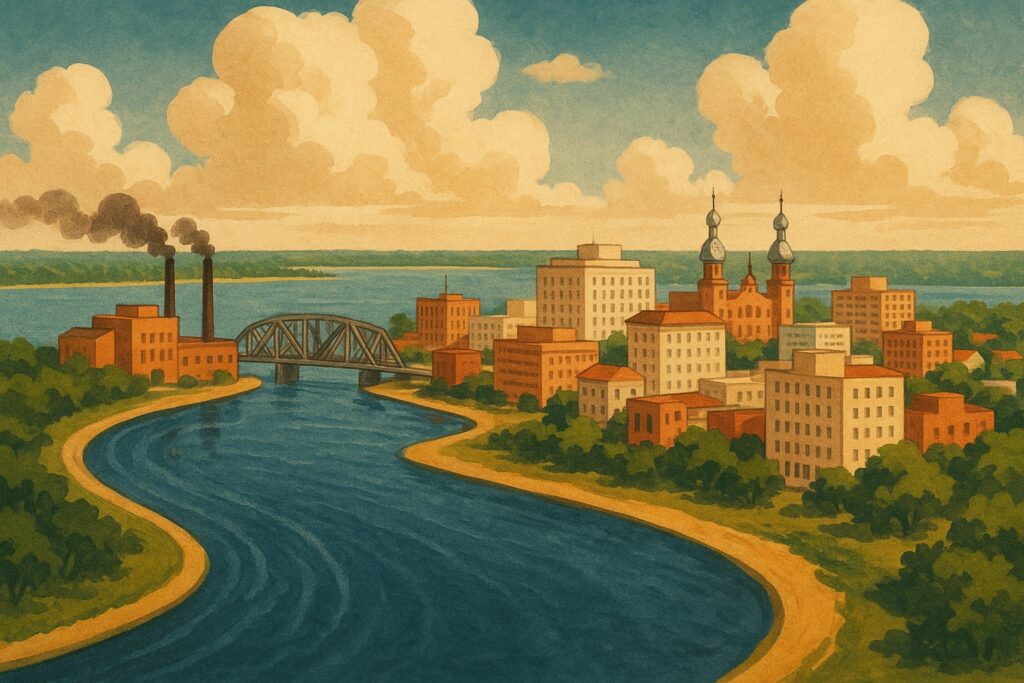
Where Land Met Water: The Natural Advantage of Tampa Bay
In the earliest maps of Florida drawn by European explorers, Tampa Bay stood out—not because it was settled or fortified, but because it was navigable. Spanning more than 400 square miles, Tampa Bay is wide, deep, and protected from open water by a natural barrier of islands and coastlines. For seafarers facing unpredictable Gulf weather, this mattered.
In an age when shipping dictated survival and trade routes dictated prosperity, a bay that could host deep-draft vessels year-round was gold. Tampa’s harbor was safer than most along Florida’s west coast, and it didn’t take long for explorers, traders, and later military strategists to take note.
This natural harbor offered more than refuge. It was a launch point—a place that made movement in and out of Florida faster and easier. That alone made Tampa different from other Florida settlements trying to push inland or establish regular shipping.
Fort Brooke: Military Beginnings on the Edge of the Wilderness
Despite Tampa’s geographical promise, it remained largely unsettled well into the 19th century. After Florida became part of the U.S. in 1821, attention turned to protecting its long coastline and vulnerable western edge. In 1824, the U.S. Army established Fort Brooke near the mouth of the Hillsborough River. It wasn’t a grand fort, but its presence was strategic.
From this modest military post, Tampa’s first wave of civilian settlement began. Soldiers brought support staff. Support staff brought families. Eventually, a small town began to take shape just outside the fort’s boundaries. It was rough and remote, but protected—and near an excellent harbor.
Fort Brooke gave Tampa something many other settlements lacked in the early 1800s: stability. In a frontier full of conflict and uncertainty, that mattered.
The Hillsborough River: Tampa’s Inland Lifeline
Geography doesn’t begin and end at the coastline. One of Tampa’s most overlooked advantages was its river—the Hillsborough—which wound its way from Florida’s interior to Tampa Bay. This river provided more than drinking water and fishing. It was a transportation artery.
Long before roads were reliable, rivers moved people and goods. Settlers and traders could float timber, cattle, citrus, and other products down the Hillsborough and into Tampa’s port. From there, goods could be shipped across the Gulf and into other American or Caribbean markets.
That inland access made Tampa a connector between Florida’s vast, wild center and the outside world. The river tied Tampa to the state’s interior economy—and made it a trade hub even before formal infrastructure arrived.
The Railroad Arrives: Unlocking Tampa’s Full Potential
By the late 1800s, the real key to explosive growth wasn’t the sea—it was steel. Railroads had begun to reshape America, and Florida was no exception. Tampa’s break came in 1884, when Henry B. Plant extended the South Florida Railroad directly into the city.
With one stroke, Tampa went from being a coastal outpost to a fully integrated part of the national economy. Freight could now move in and out quickly. People followed—workers, entrepreneurs, families.
What made this development even more impactful was that Tampa already had the port. With rail to the north and a harbor to the south, the city became a funnel for goods. Inland farms, cattle ranches, and orange groves could send their products to Tampa for export. At the same time, imported goods from ships could move inland via the rails. The city was no longer remote—it was central.
A New Kind of Industry: The Rise of the Cigar Boom
If geography brought people to Tampa, it was industry that kept them there. And the industry that truly transformed the city arrived not long after the railroad: cigars.
In the late 19th century, Tampa attracted the attention of cigar manufacturers looking for a stable, well-connected base near Cuba. Vicente Martinez-Ybor, a Cuban cigar magnate, chose Tampa as the site for a massive cigar production operation. The neighborhood he developed—Ybor City—would become one of the most famous immigrant communities in the South.
Tampa’s location made it ideal. Tobacco could be brought in from Cuba by ship, rolled in local factories, and then shipped out by rail. It was seamless. Workers came from Cuba, Spain, and Italy, bringing with them not just labor, but language, food, politics, and culture.
This wasn’t just a boom—it was a transformation. What had been a quiet outpost became a melting pot, with thousands of workers, dozens of factories, and an international reputation.
Tampa in Wartime: Geography and Strategy Collide
In 1898, Tampa’s location again put it on the national stage. As tensions escalated with Spain, Tampa was selected as the main embarkation point for American troops headed to Cuba during the Spanish-American War.
Thousands of soldiers and tons of equipment moved through the city in a matter of months. It was the first time many Americans had even heard of Tampa, but for military planners, the choice made perfect sense: a deep port, direct routes to Cuba, and a functioning rail system to move men and material. It was the ideal launch point.
While the war itself was short, the attention it brought to Tampa helped accelerate its infrastructure development. It also introduced the city to journalists, officers, and investors who returned later—not as soldiers, but as settlers and businesspeople.
A City Molded by Its Location
Looking back, it’s clear that Tampa didn’t grow by accident. Its deep harbor, inland river, and rail connections gave it advantages few other cities had in combination. Each phase of growth built on the one before it: first protection, then trade, then industry, and finally national significance.
Today, Tampa’s historic charm meets modern living in neighborhoods where restored buildings, brick streets, and classic architectural features are preserved with care. As older homes are revitalized and new ones built in traditional styles, there’s been a rising demand for wood garage door installation—blending aesthetic appeal with functionality. These garage doors not only complement Tampa’s warm, coastal design sensibilities but also add value and curb appeal to properties throughout the city.
Even today, Tampa’s success story continues to reflect its roots. The port still hums with activity. Ybor City still tells the story of its cigar-making past. The city still bridges Florida’s interior and the wider world beyond the Gulf.
When we talk about Tampa’s rise, we’re really talking about geography—not as a setting, but as a cause. The land shaped the opportunity, and the opportunity shaped the city.
The written content on this page was generated by ChatGPT.
